How to Make a Manifestation Vision Board That Works
On this page 6
A manifestation vision board is more than a collage when it's built around a specific want and looked at daily, not assembled once and left on a wall. The difference between a board that does something and one that becomes decoration isn't the images you choose — it's whether you built a habit of actually seeing it.
The craft part — cutting, pasting, arranging — is the easy half. Most vision boards that "stop working" never had a second half to begin with: no daily glance, no connection back to the journaling or affirmation practice, nothing asking anything of you after the glue dried.
The method, step by step
Start with one to three specific wants, not a whole life. A board trying to cover career, love, health, money, and travel all at once ends up crowded and vague. Pick what matters most right now — the rest can wait for the next one.
Choose images for how they make you feel, not just what they show. A photo of a kitchen you'd actually cook in does more than a generic "luxury" stock shot. Specificity is what makes an image do anything at all.
Add a few words, not just pictures. A short phrase in your own language — "steady," "paid off," "said yes" — anchors an image to what it actually means to you, which matters months later when the picture alone has gone a little abstract.
Put it somewhere you'll actually see it. A board in a closet is a project. A board by the mirror, the desk, or the inside of a closet door you open every morning is a practice.
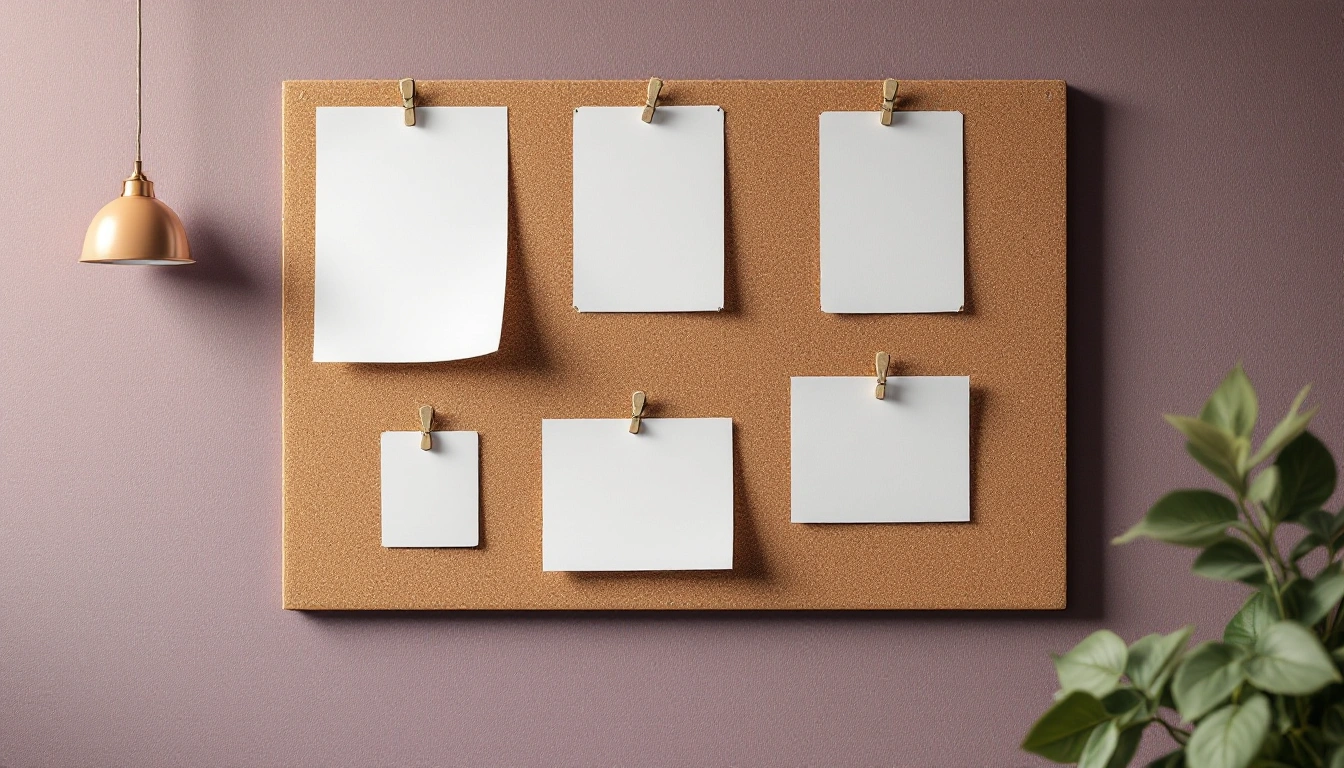
A corkboard, printed photos, and a simple frame kit covers the physical side in one go if you don't already have the basics lying around.
Turning it into a daily prompt instead of a one-time project
Building the board is the part everyone plans for. What actually keeps it working is looking at it on purpose — thirty seconds most mornings, picking one image and asking what one thing today moves you toward it. That's the piece that turns a craft afternoon into an ongoing practice.
That's the exact gap the starter quiz's prompt pack is built to fill — a daily line that ties back to what's actually on your board instead of a generic journal you'll forget by week two.
Digital vs physical, briefly
Both work the same way in principle. A physical board has presence — you walk past it, it's a real object in a real room. A digital one (a phone lock screen, a Pinterest board, a saved collage) travels with you and is easier to update. Neither format changes the mechanics; pick whichever one you'll actually look at without having to remember to.
What makes a board stop working
Usually one of three things: the images stopped matching what you actually want, because life moved and the board didn't; the board became furniture you stopped seeing because your eyes learned to skip past it; or it was built around five different goals and never felt like it belonged to any one of them. All three are fixable by rebuilding around fewer, more specific wants and moving the board somewhere your eyes haven't gone numb to yet.
A worked example
Say the specific want is "work I don't dread on Sunday nights." Instead of a generic office photo, the board gets a picture of a desk setup close to what you'd actually want, a phrase like "steady" tucked in the corner, and a small image of a clock reading a reasonable evening hour — a nod to not working late. Every morning, thirty seconds on that section, one question: what's one thing today that moves toward that. Some days the answer is an application. Some days it's just noticing you said no to a task that would have eaten your evening. Both count.
A board isn't a plan by itself
A vision board keeps a want visible. It doesn't replace the actual steps — the applications, the saving, the conversation you've been putting off. Think of it as the reminder, not the mechanism. The mechanism is still you, on an ordinary Tuesday, doing the next small thing the board is pointing at.